
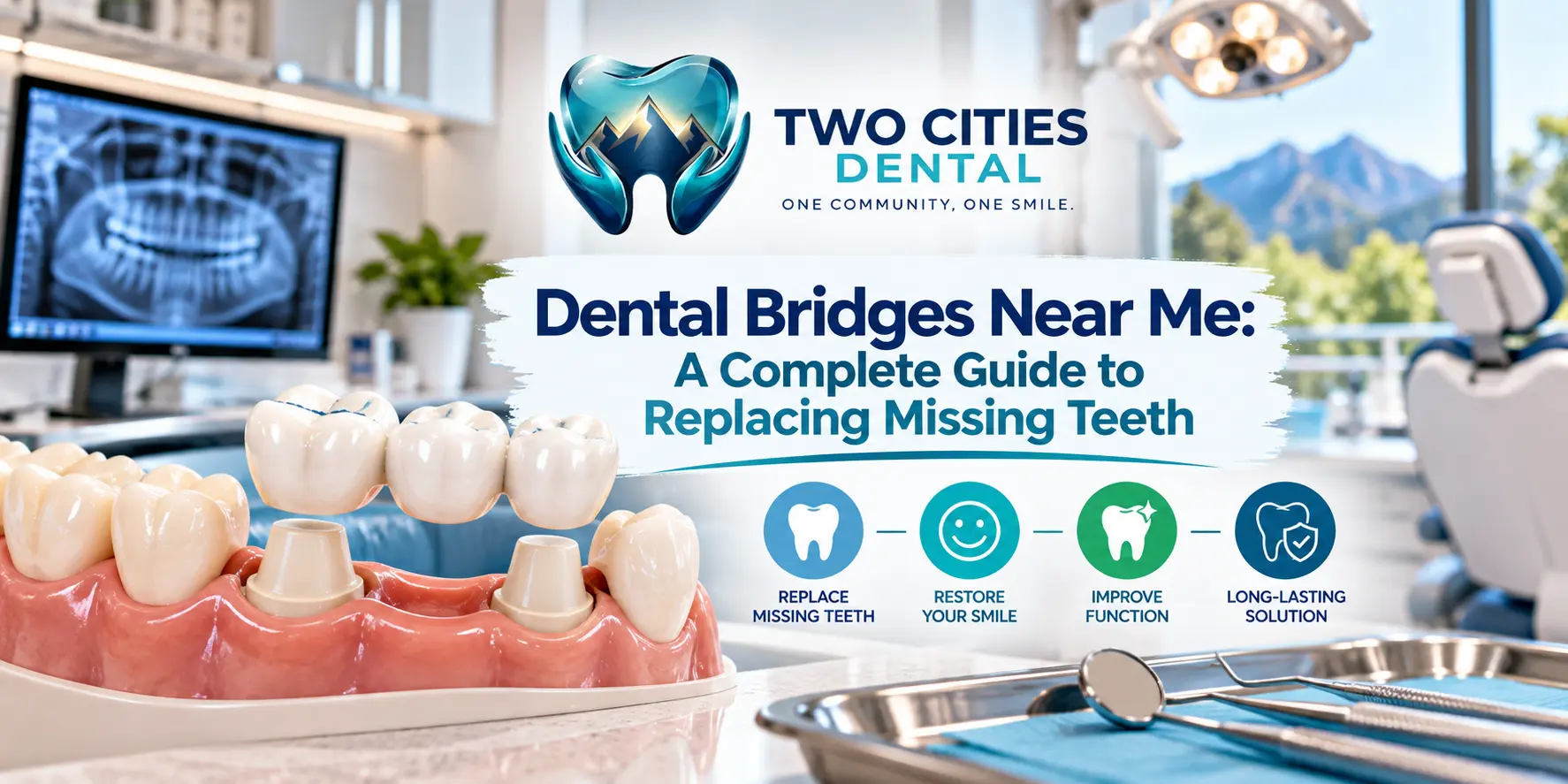
Dental Bridges Near Me: A Complete Guide to Replacing Missing Teeth
If you are searching for dental bridges near me, you may have recently lost a tooth or discovered that an existing tooth cannot be preserved. Missing teeth can affect much more than the appearance of your smile. They can make chewing more difficult, affect how your teeth come together, and leave spaces where neighboring teeth may gradually shift.
Fortunately, several restorative dental treatments can help replace missing teeth. One of the traditional options is a dental bridge.
A dental bridge is designed to replace one or more missing teeth by using a prosthetic tooth, or teeth, supported by neighboring teeth or dental implants. Depending on your oral health, the location of the missing tooth, your preferences, and your dentist’s recommendations, a bridge may provide a practical way to restore both the appearance and function of your smile.
For patients in Fresno and surrounding communities, finding a convenient dental office can make the process easier. Two Cities Dental provides a range of general, restorative, cosmetic, and preventive dental services, allowing patients to discuss tooth replacement as part of their overall oral health plan.
In this guide, we will explain what dental bridges are, how they work, who may be a candidate, what the procedure involves, how bridges compare with other tooth replacement options, and what you should consider when searching for dental bridges near me.
What Is a Dental Bridge?
A dental bridge is a fixed dental restoration used to replace one or more missing teeth.
The replacement tooth is called a pontic. It fills the space left by the missing natural tooth.
Depending on the type of bridge, the pontic may be supported by natural teeth on either side of the gap or by dental implants.
A traditional dental bridge generally consists of:
- A replacement tooth or teeth
- Dental crowns that support the replacement tooth
- Supporting teeth on one or both sides of the space
The exact design depends on the location of the missing tooth and the condition of the surrounding teeth.
Your dentist will evaluate your mouth and discuss which type of restoration may be appropriate.
Why Replace a Missing Tooth?
Some people postpone replacing a missing tooth because it does not hurt.
However, a missing tooth can affect your mouth in several ways.
Difficulty Chewing
Teeth work together as a system. Losing one tooth can change how you distribute chewing forces.
Depending on the location of the missing tooth, you may begin favoring one side of your mouth.
Changes in Tooth Position
When a tooth is missing, neighboring teeth may gradually move toward the open space.
This can change the alignment of your bite.
Changes in Your Smile
A missing tooth can be particularly noticeable when it is located toward the front of your mouth.
Even when the missing tooth is farther back, some patients may still feel self-conscious about the gap.
Food Getting Trapped
Spaces created by missing teeth can sometimes allow food to become trapped, making oral hygiene more challenging.
Changes in Your Bite
A missing tooth can change how the upper and lower teeth contact each other.
For these reasons, replacing a missing tooth may be worth discussing with a dentist even if you are not currently experiencing pain.
Who May Need a Dental Bridge?
A dental bridge may be considered when a patient has one or more missing teeth and wants a fixed restoration.
Potential candidates may include people who:
- Have lost a tooth because of decay
- Have lost a tooth because of trauma
- Need to replace a tooth that could not be saved
- Have a missing tooth between two healthy or restorable teeth
- Want a fixed alternative to a removable denture
- Are not currently candidates for a particular implant treatment
- Want to restore chewing function and the appearance of their smile
However, a bridge is not automatically appropriate for every missing tooth.
The condition of your gums, neighboring teeth, bone, bite, oral hygiene, and overall dental health all matter.
A consultation with a dentist is the best way to determine whether a bridge is appropriate.
Types of Dental Bridges
There are several different types of dental bridges.
The most appropriate option depends on the location of the missing tooth, the supporting teeth, your oral health, and the treatment plan developed by your dentist.
Traditional Dental Bridge
A traditional bridge uses crowns on the supporting teeth on either side of the missing tooth.
The crowns are connected to the artificial tooth that fills the gap.
This type of bridge has been used for many years and may be appropriate when the neighboring teeth are strong enough to support the restoration.
Cantilever Bridge
A cantilever bridge is supported on only one side.
This design is less commonly appropriate and depends heavily on the location of the missing tooth and the forces placed on the restoration.
Your dentist will determine whether this type of bridge is suitable for your particular situation.
Maryland Dental Bridge
A Maryland bridge uses a framework attached to the back of adjacent teeth rather than traditional full crowns.
This type of restoration may be considered in selected situations, particularly for certain front teeth.
However, the appropriate design depends on the individual case.
Implant-Supported Bridge
An implant-supported bridge uses dental implants rather than natural teeth as the support structure.
This can be particularly useful when several adjacent teeth are missing.
Dental implants are surgically placed into the jawbone and can then support a bridge or another type of restoration.
If you are missing multiple teeth, you may also want to explore dental implants in Clovis as part of your tooth replacement consultation.
Dental Bridges vs. Dental Implants
One of the most common questions patients have when searching for dental bridges near me is whether they should choose a bridge or dental implant.
These treatments work differently.
A traditional bridge relies on supporting teeth.
A dental implant replaces the root portion of a missing tooth and can support a crown or other restoration.
There are several factors to consider.
Dental Bridge
A bridge may:
- Replace a missing tooth without surgical implant placement
- Provide a fixed restoration
- Restore the appearance of a missing tooth
- Help restore chewing function
- Be completed without waiting for implant integration in some cases
Dental Implant
An implant may:
- Replace the missing tooth root
- Support an individual crown
- Support a bridge when multiple teeth are missing
- Avoid relying on neighboring natural teeth for support
- Provide a long-term tooth replacement option for appropriately selected patients
Neither treatment is automatically the right answer for everyone.
Your dentist can evaluate your teeth, gums, jawbone, bite, and overall oral health before discussing the available options.
Dental Bridges vs. Dentures
Another tooth replacement option is a denture.
Dentures can replace multiple missing teeth and may be either partial or complete depending on the patient’s needs.
A partial denture can replace several missing teeth while using remaining natural teeth for support.
A bridge, by contrast, is fixed in place.
If you are missing several teeth, it may be helpful to discuss dentures and tooth replacement options with your dental team and compare the advantages and limitations of each approach.
The right treatment depends on how many teeth are missing, where they are located, the health of your remaining teeth, your budget, your preferences, and your long-term dental goals.
Do Dental Bridges Look Natural?
Modern dental restorations can be designed to resemble natural teeth in shape, size, and color.
When planning a bridge, your dentist considers factors such as:
- The color of neighboring teeth
- Tooth shape
- Tooth size
- Smile appearance
- The location of the missing tooth
- Your bite
For a front tooth, cosmetic considerations may be particularly important.
Your dentist and dental laboratory can work together to create a restoration designed to blend with your existing smile.
The exact appearance depends on the materials used and the individual treatment plan.
What Happens During a Dental Bridge Consultation?
If you are considering a dental bridge, the process typically begins with a dental examination.
Your dentist will evaluate the missing tooth area and surrounding teeth.
The examination may include:
- Visual examination
- Dental X-rays
- Gum evaluation
- Bite assessment
- Evaluation of supporting teeth
- Review of your dental history
- Discussion of your treatment goals
X-rays may be particularly useful because they allow the dentist to evaluate areas that cannot be fully seen during a visual examination.
If you have not had a dental examination recently, you can also discuss dental exams and X-rays with the dental team before planning restorative treatment.
What Happens During the Dental Bridge Procedure?
The exact procedure depends on the type of bridge you receive.
For a traditional bridge, the supporting teeth generally need to be prepared so that the crowns can fit properly.
Your dentist will carefully shape the supporting teeth according to the restoration design.
An impression or digital scan may then be taken so that the dental laboratory can create the bridge.
A temporary restoration may be placed while the permanent bridge is being fabricated.
Once the permanent bridge is ready, you will return to the dental office.
The dentist will evaluate:
- Fit
- Bite
- Shape
- Color
- Comfort
- Overall appearance
If everything is satisfactory, the bridge can be permanently cemented or attached according to the treatment plan.
Does Getting a Dental Bridge Hurt?
The dental bridge procedure itself is generally performed using local anesthesia when necessary.
This helps keep the supporting teeth comfortable during preparation.
After the appointment, some patients may experience temporary sensitivity or gum tenderness.
This is particularly possible when the supporting teeth have been prepared.
Your dentist will provide instructions about caring for the area after treatment.
If you experience persistent or severe pain after a bridge procedure, contact your dental office so the cause can be evaluated.
How Long Does a Dental Bridge Take?
The timeline varies depending on the type of bridge, the number of teeth involved, the condition of your mouth, and whether additional treatment is necessary.
A straightforward traditional bridge may require multiple appointments.
If you need other treatment first, the overall timeline may be longer.
For example, you may need:
- A dental filling
- Gum disease treatment
- Root canal treatment
- A crown
- Tooth extraction
- Bone-related treatment
- Temporary restoration
Your dentist can provide a more specific timeline after evaluating your mouth.
What If the Supporting Tooth Needs a Root Canal?
Sometimes a tooth that would otherwise support a bridge has extensive decay or damage.
If the tooth can be preserved but the pulp has been affected, root canal treatment may be recommended.
The goal is to treat the diseased pulp and preserve the tooth when possible.
If you are experiencing persistent tooth pain or sensitivity, do not assume that you simply need a bridge.
An examination is necessary to determine the cause.
You can learn more about root canal treatment and discuss whether treatment is needed before proceeding with a restoration.
What If the Supporting Teeth Have Cavities?
Supporting teeth need to be strong enough to serve their role.
If a supporting tooth has significant decay, your dentist may need to treat the decay before designing the bridge.
A smaller cavity may require a filling, while a severely damaged tooth may require more extensive treatment.
This is one reason a comprehensive dental examination is important before choosing a bridge.
Can a Dental Bridge Replace More Than One Tooth?
Yes, certain bridge designs can replace multiple adjacent missing teeth.
For example, a bridge may be used when two or more neighboring teeth are missing.
However, the number of teeth that can safely be replaced depends on the support available and the forces created by chewing.
Longer bridges require careful planning.
Your dentist will evaluate whether the supporting teeth or implants can safely handle the restoration.
How Do You Care for a Dental Bridge?
Proper maintenance is important for protecting both the bridge and the teeth supporting it.
A bridge does not mean that you can stop brushing or cleaning between your teeth.
In fact, cleaning around and underneath the restoration is especially important.
Brush Twice Daily
Brush your teeth twice a day using fluoride toothpaste unless your dentist recommends another routine.
Clean Under the Bridge
Food and plaque can accumulate underneath the artificial tooth.
Your dental team can show you how to clean this area effectively.
Depending on your bridge design, you may use:
- Floss threaders
- Specialized dental floss
- Interdental brushes
- Water flossers
- Other cleaning tools
Maintain Regular Dental Visits
Professional cleanings and dental examinations allow your dental team to monitor the bridge and the supporting teeth.
Two Cities Dental provides preventive dental services that can help patients maintain their oral health over time.
If you need professional maintenance, ask about routine dental cleanings as part of your ongoing care.
What Can Cause a Dental Bridge to Fail?
A bridge can be a durable restoration, but several factors can affect its longevity.
These may include:
- Poor oral hygiene
- Tooth decay around supporting teeth
- Gum disease
- Excessive biting forces
- Teeth grinding
- Trauma
- Improper cleaning
- Problems with the supporting teeth
For patients who grind or clench their teeth, a dentist may recommend a night guard.
If you wake up with jaw discomfort or have noticeable tooth wear, mention this during your dental examination.
Can a Dental Bridge Get a Cavity?
The artificial tooth itself cannot develop a traditional cavity because it is not natural tooth structure.
However, the natural teeth supporting the bridge can develop decay.
This is one of the most important reasons to maintain good oral hygiene around a bridge.
Plaque accumulation near the margins of supporting crowns can contribute to decay or gum problems.
Regular professional cleanings and examinations can help your dental team monitor these areas.
What Happens If a Dental Bridge Feels Loose?
A bridge should feel stable.
If you notice movement, discomfort, unusual sensitivity, or a change in your bite, contact your dentist.
Do not attempt to repair or re-cement the bridge yourself.
A loose bridge can sometimes indicate:
- Cement failure
- Decay
- Damage to a supporting tooth
- Gum disease
- Fracture
- Changes in the supporting tooth
Prompt evaluation can help identify the cause.
Dental Bridges and Gum Health
Healthy gums are important for successful restorative dentistry.
If you have gum disease, your dentist may recommend periodontal treatment before placing a bridge.
Symptoms of gum problems can include:
- Bleeding while brushing
- Red or swollen gums
- Persistent bad breath
- Gum recession
- Tender gums
- Loose teeth
If you experience these symptoms, mention them during your dental examination.
Treating gum problems can help create a healthier foundation for restorative dental work.
What If You Have an Emergency With Your Bridge?
Dental emergencies can happen even when you take good care of your restoration.
You may experience:
- A broken bridge
- A loose bridge
- Severe tooth pain
- Damage to a supporting tooth
- Swelling
- Dental trauma
If you experience a dental problem that requires prompt attention, contact a dental office as soon as possible.
You can also review emergency dental care options and discuss the appropriate next step with your dental team.
If you have severe facial swelling that affects breathing or swallowing, or if you have suffered significant trauma, seek emergency medical attention.
How Long Can Dental Bridges Last?
The lifespan of a dental bridge varies.
Factors that can influence longevity include:
- Oral hygiene
- Gum health
- Supporting tooth health
- Bite forces
- Teeth grinding
- Diet
- Regular dental care
- The quality and type of restoration
- Accidental trauma
A bridge does not eliminate the need for regular dental care.
In fact, maintaining the supporting teeth is essential to protecting the restoration.
Your dentist can monitor the bridge during routine examinations and identify potential problems early.
Is a Dental Bridge Better Than Leaving the Gap?
A missing tooth should not automatically be treated with a bridge.
However, leaving a missing tooth unreplaced can have consequences depending on its location and your individual bite.
Potential concerns include:
- Tooth movement
- Changes in chewing
- Food trapping
- Changes in bite
- Cosmetic concerns
Your dentist can evaluate the specific situation and explain whether replacement is recommended.
In some cases, monitoring the space may be reasonable.
In other situations, replacing the tooth may help maintain function and oral health.
What Does a Dental Bridge Cost?
The cost of a dental bridge varies considerably.
Several factors influence the total cost, including:
- Number of missing teeth
- Type of bridge
- Materials used
- Condition of supporting teeth
- Additional dental treatment
- Need for temporary restorations
- Dental insurance
- Laboratory fees
Because every case is different, it is difficult to provide an accurate price without an examination and treatment plan.
If cost is an important consideration, ask your dental office for a written treatment estimate and discuss available payment or insurance options.
How to Find Dental Bridges Near Me
When searching online for dental bridges near me, location is only one factor to consider.
A convenient dental office is helpful, but you should also consider whether the practice can provide the broader services you may need.
For example, restorative patients may benefit from access to:
- Dental examinations
- X-rays
- Preventive cleanings
- Fillings
- Crowns
- Root canal treatment
- Dental implants
- Dentures
- Emergency dentistry
- Cosmetic dentistry
Having these services available can make treatment planning more convenient.
You can also consider factors such as:
Location
Choose an office that is reasonably convenient from your home or workplace.
Experience
Ask about the dentist’s experience with bridges and other restorative treatments.
Treatment Options
A good consultation should explain more than one potential option when appropriate.
Communication
Your dentist should explain the proposed treatment and answer your questions.
Follow-Up Care
Ask how the office handles adjustments and maintenance after your bridge is placed.
Questions to Ask Before Getting a Dental Bridge
Before proceeding, consider asking:
1. Is a bridge the right option for me?
There may be several ways to replace a missing tooth.
2. Which type of bridge do you recommend?
Ask why a particular design is appropriate for your situation.
3. What will happen to my supporting teeth?
Understanding how the teeth will be prepared can help you make an informed decision.
4. Do I need treatment before getting the bridge?
You may need fillings, gum treatment, root canal therapy, or another procedure first.
5. How long will the process take?
Ask about the number of appointments and expected timeline.
6. How should I clean underneath the bridge?
Your dentist or hygienist can demonstrate the correct technique.
7. What are my alternatives?
Depending on your situation, alternatives may include an implant, partial denture, or another restoration.
8. How should I protect my bridge?
If you grind your teeth or participate in contact sports, additional protection may be recommended.
Why Preventive Care Matters After Getting a Bridge
A dental bridge replaces a missing tooth, but it does not eliminate the need for preventive care.
Regular dental examinations allow your dentist to check:
- The bridge
- Supporting teeth
- Gum health
- Bite
- Other teeth
- Oral hygiene
Professional cleanings can remove plaque and tartar that are difficult to eliminate at home.
Your dentist may also identify early signs of decay or gum disease around the supporting teeth.
This ongoing care is an important part of protecting your investment in your smile.
Restoring Your Smile With Two Cities Dental
If you are searching for dental bridges near me in Fresno, a consultation with a local dental practice can help you understand your options.
Two Cities Dental provides a variety of dental services designed to address preventive, restorative, cosmetic, and urgent dental needs.
A missing tooth does not necessarily mean that you need a bridge.
Depending on your situation, your dentist may discuss options such as a traditional bridge, implant-supported restoration, dental implant, partial denture, or another treatment.
The best way to determine the appropriate option is to have your teeth and gums examined and discuss your goals with your dentist.
If you have a missing tooth, don’t wait until the space begins causing additional problems before asking about your options.
A dental evaluation can help you understand:
- Why the tooth was lost
- Whether the neighboring teeth are healthy
- Whether your gums are healthy
- Whether a bridge is appropriate
- Whether an implant may be an alternative
- What treatment timeline to expect
- How to maintain the restoration afterward
Final Thoughts
Searching for dental bridges near me is often the first step toward replacing a missing tooth and restoring your smile.
Dental bridges can provide a fixed way to fill a gap and restore aspects of chewing and appearance. However, the right solution depends on your individual dental condition.
Before choosing a bridge, your dentist should evaluate the missing tooth area, supporting teeth, gums, bite, and overall oral health.
Other options, including dental implants and dentures, may also be appropriate depending on your circumstances.
Most importantly, tooth replacement should be considered as part of a long-term oral health plan rather than simply a cosmetic procedure.
If you have a missing tooth or are considering replacing an existing restoration, schedule a consultation with Two Cities Dental to discuss your options and determine which approach may be appropriate for your smile.