
A dental implant is a small post that is made up of titanium, bicarbonate metal, or a combination of the two. It is typically inserted into an empty socket of the gums left by a missing tooth.

Join 1,000's of patients
who trust our care
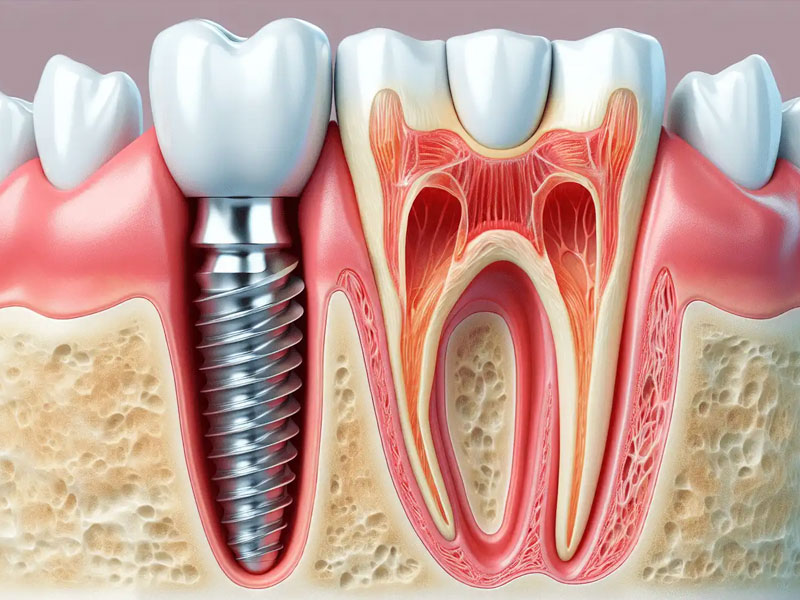
Dental implants are designed to replace missing tooth roots and provide a secure foundation for a dental crown, bridge, or denture. After placement, the implant gradually integrates with the surrounding jawbone, helping create a stable support for your replacement tooth.
When a natural tooth is lost, the surrounding bone may gradually decrease because it no longer receives stimulation from the tooth root. Dental implants can help maintain the structure of the jawbone while restoring the appearance and function of your smile.
A single dental implant can support an individual crown, while multiple implants may be used to support a dental bridge, partial denture, or full-arch restoration. Your dentist will evaluate your oral health and discuss the most appropriate tooth replacement option for your needs.

Dental Implants
Complimentary Consultation
Can't find what you're looking for? Give us a call at and our friendly dental receptionist will gladly answer any questions you may have.
Dental Implants can develop problems without consistent daily care. The earliest sign of a problem begins with the observation of bleeding. This is known as mucositis. The current scientific evidence suggests that this may be successfully treated and is reversible if caught early. Unfortunately, if it progresses to bone loss, also known as peri-implantitis, the bone loss is not reversible. If peri-implantitis is not treated it can lead to advanced bone loss and the removal of the implant.
During routine visits, your dentist or hygienist can evaluate the gums and tissues surrounding your dental implant, check for signs of inflammation, examine the implant restoration, and assess your bite.
Your dentist may also recommend periodic X-rays when appropriate to monitor the bone supporting the implant. Regular routine cleanings and professional examinations are an important part of maintaining your oral health.
Dental implants may be considered when you are missing one or more teeth because of injury, decay, gum disease, or another dental condition. Whether implants are appropriate depends on factors such as your jawbone, gum health, overall oral health, and treatment goals.
Our dentist will evaluate your teeth and gums and discuss the available options with you. Depending on your situation, alternatives may include dental bridges or dentures.
If there is not enough healthy bone to support an implant, your dentist may also discuss additional treatment, such as a bone graft, before implant placement.
Before receiving dental implants, our dentist will perform a thorough examination and review your dental and medical history. Dental X-rays may be recommended to evaluate the teeth, jawbone, and surrounding structures.
Your dentist will explain the treatment process and provide specific instructions based on your individual needs. Be sure to follow all pre-treatment instructions and tell your dental team about medications, medical conditions, or concerns that may affect your treatment.
Dental implant treatment may involve several stages, depending on your oral health and the number of teeth being replaced. Local anesthesia is commonly used during implant placement to help keep you comfortable.
During the first stage, the implant post is carefully placed into the jawbone at the planned treatment site. The gum tissue may then be closed over or around the implant while the area heals. Over time, the implant can integrate with the surrounding bone and become a stable foundation for your replacement tooth.
After the implant has healed sufficiently, an abutment may be attached. The abutment connects the implant to the final restoration, such as a dental crown, bridge, or denture. Our dentist will determine the appropriate treatment sequence based on your individual case.
For patients who need additional surgical treatment, our oral surgery services may be part of the overall treatment plan.
Following your successful procedure, it is normal to experience some pain, swelling, and minor bleeding and you may be prescribed pain medication and/or antibiotics to control possible infection. Our dentist will sit with you to show you proper cleaning techniques for your new teeth and give you advice on what to eat and drink in the weeks following your procedure. Initially, you might need to stick to soft foods while the implant heals.
In stage one, our dentist places the metal implant into your jawbone under the gum tissue. It needs to be inserted deep into the jawbone, as this will serve as the best anchor for your new tooth. The gums are then stitched back into place. As gum tissue heals, the implant begins to bond with the bone and attach to the gum. The entire healing process may take several months. Contact us if you are feeling anything unusual during the healing process.
The placing of an abutment is also part of the procedure, but it is possible this part of the procedure might need to be done at a later time. The abutment is the piece where the replacement tooth will attach to the implant.
The final stage is placing your replacement tooth or teeth. Getting to this step might require a bit more healing time because your jawbone needs to be strong enough before the new tooth is placed. Our dentist will take impressions to ensure your replacement teeth are an appropriate fit and then insert them following the exact specifications of your case.
Pick a time and your preferred dentist. We'll text or call you to confirm.

We are a family-owned & operated dental office serving the great two cities of Fresno & Clovis.
© 2026 Two Cities Dental in Fresno/Clovis. All Rights Reserved.